How Long Does It Take a Submitted Article to Be Peer Reviewed?
The MDPI Editorial Procedure
MDPI operates a rigorous and transparent peer-review procedure that aims to maximize quality. Peer-review is handled by researchers and scholars.
We believe that peer-review needs to be efficient, rigorous, and off-white for everyone involved.
In virtually MDPI journals, peer-review is a unmarried-bullheaded assessment with at least ii independent reviewers, followed by a final acceptance/rejection conclusion past the Editor-in-Chief, or another bookish editor approved by the Editor-in-Chief. The Editor-in-Master is responsible for the academic quality of the publication process, including acceptance decisions, blessing of Guest Editors and Special Issue topics, and appointing new Editorial Board members.
A summary of the editorial procedure is given in the flowchart beneath.
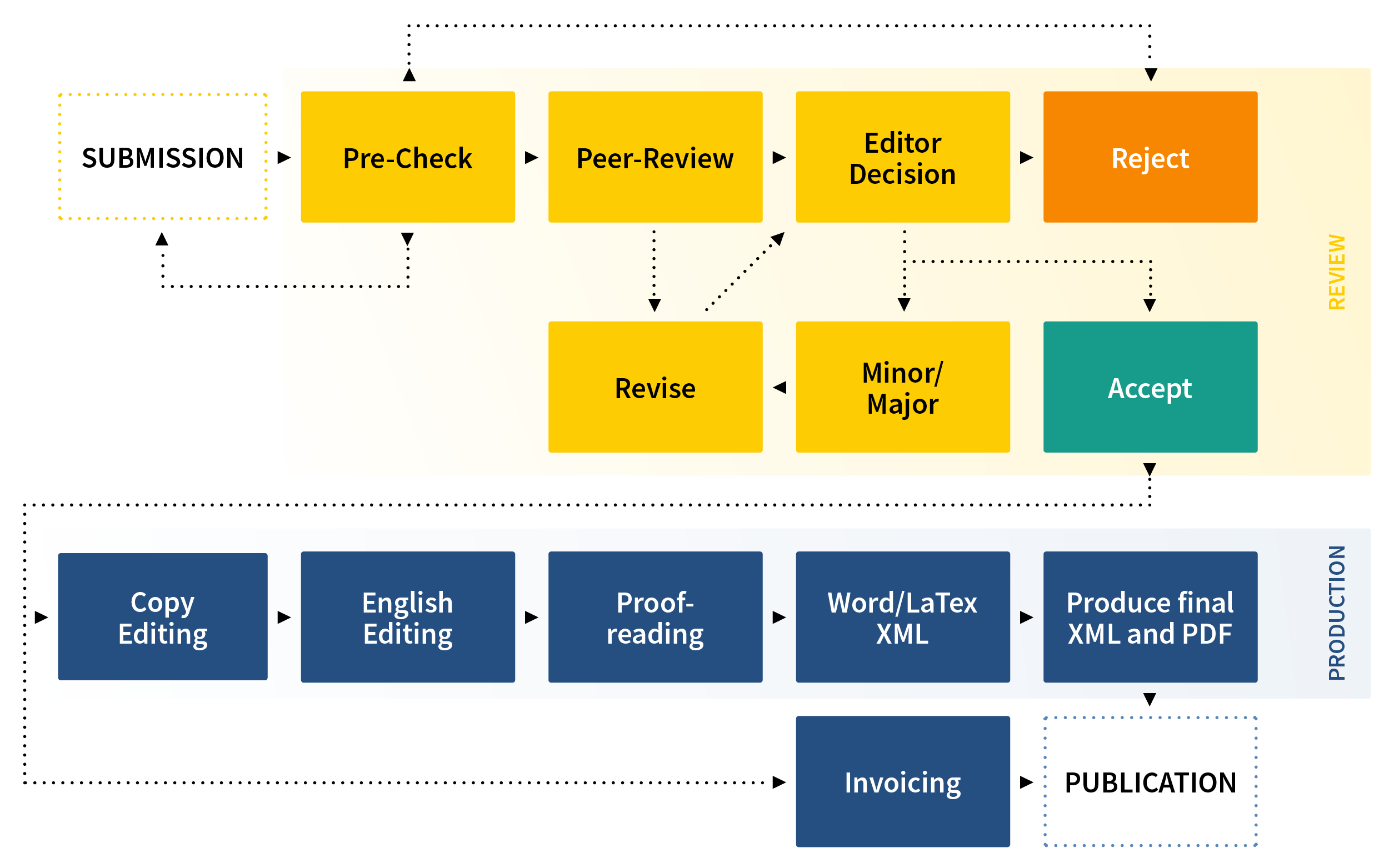
The MDPI editorial process.
The post-obit provides notes on each step.
Pre-check
Immediately after submission, the periodical's Managing Editor will perform an initial cheque to assess:
- Overall suitability of the manuscript to the journal/section/Special Result;
- Manuscript adherence to high quality research and ethical standards;
- Standards of rigor to qualify for farther review.
The academic editor, i.e., the Editor-in-Main in the case of regular submissions, or the Guest Editor in the case of Special Issue submissions, or an Editorial Lath member in case of a disharmonize of involvement and of regular submissions if the Editor-in-Chief allows, will exist notified of the submission and invited to perform a check and recommend reviewers. Academic editors can decide to continue with the peer-review process, reject a manuscript, or request revisions before peer-review.
Guest Editors of Special Issues are non able to take decisions regarding their own manuscripts submitted to their Special Issue, equally this would constitute a conflict of interest. An Editorial Board member will instead be responsible for decision making. The Guest Editor will be unable to access the review procedure except in their role as author. Similarly, Editors-in-Main, or other Editorial Board members are not able to admission the review process of their manuscript except in their function as writer.
Peer-review
From submission to final decision or publication, one dedicated MDPI staff member coordinates the review process and serves equally the main indicate of contact for authors, academic editors and reviewers.
The procedure is single-blind for most journals, meaning that the author does not know the identity of the reviewer, but the reviewer knows the identity of the writer. Some MDPI journals operate double-blind peer-review, where in addition to the writer not knowing the identity of the reviewer, the reviewer is unaware of the author'south identity.
At least two review reports are nerveless for each submitted commodity. Suggestions of reviewers can be made by the academic editor during pre-cheque. Alternatively, MDPI editorial staff will use qualified Editorial Board members, qualified reviewers from our database, or new reviewers identified by web searches for related articles.
Authors can recommend potential reviewers. MDPI staff ensure that there are no potential conflicts of interest and volition not consider those with competing interests. Authors can likewise enter the names of potential peer-reviewers they wish to exclude from consideration in the peer-review of their manuscript, during the initial submission of the manuscript. The editorial team volition respect these requests as long as they practise not interfere with the objective and thorough assessment of the submission.
If the journal has a reviewer board, these reviewers could apply to review a submitted manuscript should the authors agree with this option during submission.
The following checks are applied to all reviewers:
- That they hold no conflicts of involvement with the authors, including if they have published together in the last 5 years;
- That they hold a PhD (exceptions are made in some fields, e.g., medicine);
- They must accept recent publications in the field of the submitted paper;
- They have not recently been invited to review a manuscript for any MDPI journal.
Reviewers who accept to review a manuscript are expected to:
- Have the necessary expertise to approximate manuscript quality;
- Provide quality review reports and remain responsive throughout peer-review;
- Maintain standards of professionalism and ethics.
Reviewers who accept a review invitation are provided vii–x days to write their review via our online platform, SuSy. Extensions can be granted on request.
For the review of a revised manuscript, reviewers are asked to provide their report within three days. Extensions can also be granted on asking.
To assist academic editors, MDPI staff handle all advice with reviewers, authors, and the external editor. Academic editors can bank check the status of manuscripts and the identity of reviewers at any fourth dimension, and are able to discuss manuscript review at any stage with MDPI staff.
Open Peer-Review Option
MDPI journals operate an open peer-review option, meaning that the authors have the pick to publish the review reports and author responses with the published paper (ofttimes referred to every bit open reports). In addition, reviewers may cull to sign their reports if the review is published, in which case the reviewer name appears on the review report (referred to every bit open up identity). The default option is for reviewers to remain anonymous and for reports not to be published, reviewers and authors respectively must opt into this option. If an commodity is rejected no details will exist published. Open peer-review has the benefit of increasing transparency virtually the review process and providing further information about the paper for interested readers. Nosotros encourage authors to choose open review. Further information can be institute on our blog.
Revision
In cases where only minor or major revisions are recommended, MDPI staff volition request that the writer revise the paper before referring to the academic editor. In cases of alien review reports, or where there are one or more recommendations for rejection, the academic editor will be requested for their sentence before a decision about revisions is communicated to authors.
Revised versions of manuscripts may or may not be sent to reviewers, depending on whether the reviewer requested to see the revised version. By default, reviewers who request major revisions or recommend rejection will be sent the revised manuscript. All reviewers can access the almost contempo version of the manuscript via SuSy.
A maximum of two rounds of major revision per manuscript is normally provided. If more rounds are required according to the reviewers, MDPI staff asking a decision from the academic editor.
Editor Decision
Acceptance decisions on manuscripts tin be taken by the academic editor afterward peer-review once a minimum of 2 review reports have been received. Acceptance decisions are taken past an academic editor (the Editor-in-Primary, a Guest Editor, or another suitable Editorial Board member). Guest Editors are not able to take decisions on their own papers which will instead be assigned to a suitable Editorial Board fellow member. When making a decision, we look that the bookish editor checks the post-obit:
- The suitability of selected reviewers;
- Capability of reviewer comments and author response;
- Overall scientific quality of the paper.
The academic editor tin can select from the following options: Accept in current grade, take with small revisions, reject and decline resubmission, pass up but encourage resubmission, ask author for revision, or ask for an additional reviewer.
Reviewers make recommendations, and the Editors-in-Chief or academic editors are gratuitous to disagree with their views. If they practice so, they should justify their decision for the do good of the authors and reviewers.
In some instances, an academic editor supports a decision of manuscript acceptance despite a reviewer recommendation to reject. MDPI staff will seek a second independent stance from an Editorial Board member or the Editor-in-Primary before communicating a final determination to the authors.
Articles tin only exist accepted for publication by an academic editor. Employed MDPI staff then inform authors. MDPI staff never accept acceptance decisions on papers.
MDPI staff or Editorial Lath members (including Editors-in-Main) are not involved in the processing of their own bookish work. Their submissions are assigned and revised by at to the lowest degree 2 independent reviewers. Decisions are fabricated by other Editorial Board members who do not have a disharmonize of interest with the authors.
MDPI is a signatory of the 2012 San Francisco Annunciation on Research Assessment (DORA). We aim to publish all manuscripts that are scientifically correct, and do not artificially increase journal rejection rates, allowing the reader community at big to define bear upon.
Production
MDPI's in-house teams perform product on all manuscripts, including language editing, copy editing, and conversion to XML. Language editing is carried out by professional person English editing staff. In the small number of cases where all-encompassing editing or formatting is required, we offer authors an English editing service for an boosted fee (with authors' prior approval). The authors are besides free to apply other English editing services, or consult a native English-speaking colleague—the latter being our preferred selection.
Publication Ethics
MDPI is a member of the Committee on Publication Ethics (COPE), including following its Principles of Transparency and Best Practice in Scholarly Publishing. Our journals follow COPE'due south procedures for dealing with potentially unethical beliefs by authors, reviewers, or editors. All MDPI editorial staff are trained in how to detect and respond to upstanding problems.
Details on ethical considerations for submitting papers tin can exist found in the instructions for authors of journals (see here, for example). Please refer to our policy regarding Updating Published Papers.
Ethical issues raised by readers of the journal will exist investigated past the editorial office following procedures recommended by COPE. Disputes on the validity of inquiry reported in published papers tin can be settled by the Editorial Board. For disputes around authorship, data ownership, author misconduct, etc., where necessary, we volition refer to external organizations such as a university ethics committee. Authors are asked to respond to any substantiated allegations made against them.
To manage authorship disputes nosotros follow COPE guidelines, especially How to spot authorship issues. Typically, if all authors agree, the authorship can be updated via a Correction. If non, we require an administrative statement from the authors' institution(southward) about who qualifies for authorship.
Publishing Standards and Guidelines
MDPI follow the following guidelines and standards for its journals:
ICMJE: Medically-related MDPI journals follow the recommendations of the International Committee of Medical Periodical Editors. The guidelines comprehensively cover all aspects of editing, from how the journal is managed to details well-nigh peer-review and handling complaints. The majority of the recommendations are non specific to medical journals and are followed past all MDPI journals.
The Consort statement covers reporting of randomized, controlled trials. We encourage authors to verify their work against the checklist and menstruum diagram and upload them with their submission.
TOP covers transparency and openness in the reporting of inquiry. Our journals aim to exist at level 1 or 2 for all aspects of TOP. Specific requirements vary between journals and can be requested from the editorial office.
FAIR Principles encompass guidelines to improve the Findability, Accessibility, Interoperability and Reuse of data.
PRISMA covers systematic reviews and meta-analyses. Authors are recommended to complete the checklist and flow diagram and include it with their submission.
Get in contains guidelines for reporting in vivo experiments. Authors are recommended to verify their work against the checklist and include it with their submission.
iThenticate is an manufacture-standard software for plagiarism detection. Used during the first screening of a manuscript or pre-bank check, it can also be used at any stage of the peer-review process and especially before credence of a manuscript for publication.
Compliance with the standards and guidelines above volition exist taken into account during the last decision and whatever discrepancies should exist clearly explained by the authors. We recommend that authors highlight relevant guidelines in their cover letter of the alphabet.
Editorial Independence
All articles published by MDPI are peer-reviewed and assessed by our contained Editorial Boards, and MDPI staff are non involved in decisions to accept manuscripts. When making a decision, we expect the academic editor to brand it based solely upon:
- The suitability of selected reviewers;
- Adequacy of reviewer comments and author response;
- Overall scientific quality of the paper.
In all of our journals and in every aspect of our operation, MDPI policies are informed by the mission to brand scientific discipline and research findings open and accessible every bit widely and rapidly as possible.
Source: https://www.mdpi.com/editorial_process
0 Response to "How Long Does It Take a Submitted Article to Be Peer Reviewed?"
Postar um comentário