Whats the Name of That Theater Again I Dont Mean to Be
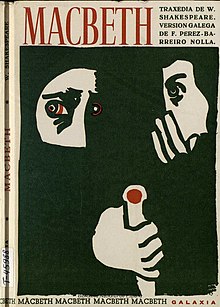
The Scottish play and the Bard'southward play are euphemisms for William Shakespeare'south Macbeth. The first is a reference to the play's Scottish setting, the second a reference to Shakespeare's popular nickname. Co-ordinate to a theatrical superstition, called the Scottish curse, speaking the name Macbeth inside a theatre, other than as called for in the script while rehearsing or performing, will cause disaster. A variation of the superstition also forbids quoting lines from the play within a theatre except as function of an actual rehearsal or performance of the play.
Because of this superstition, the pb character is oft referred to equally the Scottish King or Scottish Lord. Lady Macbeth is often referred to as the Scottish Lady. Sometimes Mackers or MacB is used to avoid proverb the name.[1]
Origins [edit]
The traditional origin is said to be a curse set upon the play by a coven of witches, angry at Shakespeare for using a real spell.[ii] 1 hypothesis for the origin of this superstition is that Macbeth, being a popular play, was commonly put on by theatres in financial trouble, or that the high production costs of Macbeth put theatres in financial trouble, and hence an clan was made between a product of Macbeth and theatres going out of business.[3]
Cleansing rituals [edit]
When the name of the play is spoken in a theatre, tradition requires the person who spoke it to get out, perform traditional cleansing rituals, and be invited back in. The rituals are supposed to ward off the evil that uttering the play's proper name is feared to bring on.
The rituals include turning three times, spitting over one's left shoulder, swearing, or reciting a line from another of Shakespeare's plays.[4] Popular lines for this purpose include, "Angels and ministers of grace defend us" (Hamlet one.Four), "If nosotros shadows have offended" (A Midsummer Nighttime'southward Dream 5.ii), and "Fair thoughts and happy hours attend on y'all" (The Merchant of Venice, 3.Four).[iv] A more elaborate cleansing ritual involves leaving the theatre, spinning effectually and brushing oneself off, and saying "Macbeth" 3 times earlier inbound once more. Some production groups insist that the offender may not re-enter the theatre until invited to do so, therefore making it like shooting fish in a barrel to punish frequent offenders past leaving them exterior.
A portrayal of the ritual occurs in the 1983 film The Dresser, in which Sir is the offender, and Norman, his dresser, officiates over the propitiation.
The cleansing rituals accept been parodied numerous times in popular culture, including in Blackadder, Slings and Arrows, The Simpsons, The West Wing, and Make It Pop.[5] For example, in the Blackadder episode "Sense and Senility", a parody ritual performed past 2 actors involves slapping each other's hands pat-a-cake style with a speedily-spoken ritual ("Hot potato, orchestra stalls, Puck will make amends"), followed by tweaking the other person's nose. In Slings and Arrows, a guest director mocks the superstition past saying the word "Macbeth" onstage, spins effectually, and falls off on her third spin, resulting in an injury that takes her out of commission for the rest of the flavor. On The Simpsons, the core five are invited into a performance by Ian McKellen (in Scottish attire, clearly in the title function). The family keeps saying the title, which simply makes more bad luck strike the actor, including lightning striking him and the "MAC" falling from the signage (leaving the "BETH").[vi]
Patrick Stewart, on the radio program Ask Me Another, asserted "if you accept played the role of the Scottish thane, then you are allowed to say the title, any fourth dimension anywhere."[vii]
Historical mishaps [edit]
Further instances include: The Astor Place Riot in 1849, injuries sustained past actors at a 1937 performance at The Old Vic that starred Laurence Olivier, Diana Wynyard'southward 1948 accidental fall, and burns suffered by Charlton Heston in 1954.[8]
English language actor Harold Norman was mortally wounded in a sword fight during a operation of Macbeth at London'southward Repertory Theatre on thirty Jan 1947. He died in infirmary iii weeks later on.[9]
On 2 Dec 1964 a burn down burned down the D. Maria II National Theater in Lisbon, Portugal. At the time, the play being shown was Macbeth.[x]
In 1980, a production of Macbeth at The Old Vic starring Peter O'Toole, frequently referred to every bit Macdeath, was performed. It was reviewed so desperately that the theatre company disbanded shortly after the play.[11]
Mishaps on the ready of his moving-picture show Opera led director Dario Argento to believe that the film had been affected by the Macbeth curse; the opera being performed within the film is Verdi'southward Macbeth.[12] [ failed verification ]
In 1988, Bulgarian singer, coach and translator Bantcho Bantchevsky committed suicide during a nationally broadcast matinee of Giuseppe Verdi's opera Macbeth. He propelled himself backwards from a balcony railing at New York's Metropolitan Opera House, Lincoln Square.[13]
Ari Aster, author and director of Hereditary, said that during filming, "Alex Wolff told me not to say the name of William Shakespeare'south Scottish play out loud because of some superstitious theater legend. I smugly announced the proper name, and then one of our lights burst during the shooting of the following scene."[14]
At the 94th Academy Awards, Chris Stone congratulated Denzel Washington on his operation in The Tragedy of Macbeth, maxim the name of the Scottish play aloud in the Dolby Theatre. Moments later, Rock was slapped past Will Smith later on making a joke about Smith's wife, Jada Pinkett Smith. Viewers, including playwright Lynn Nottage, quickly took to social media to joke that Rock had suffered the curse of the Scottish play.[15]
See also [edit]
- Curse of Scotland, a nickname for the nine of diamonds playing card
Notes [edit]
- ^ David Lyman. "This bear witness is so cursed, yous can't even telephone call it by name".
- ^ "The Expletive of the Scottish Play". RSC.org.uk. Royal Shakespeare Company. Retrieved eight October 2021.
- ^ Harrison, Martin (1998). The Language of Theatre. Routeledge. p. 239. ISBN0-87830-087-two.
- ^ a b Garber, Marjorie B. (1997). Shakespeare'due south Ghost Writers: Literature equally Uncanny Causality. Methuen. p. 88. ISBN0-416-09432-v.
- ^ Laurie Maguire and Emma Smith (2012). 30 Great Myths near Shakespeare. John Wiley & Sons. p. 151. ISBN978-1118324875.
- ^ Burt, Richard (2007). Shakespeares subsequently Shakespeare: an encyclopedia of the Bard in mass media and pop civilization, Volume 2. Greenwood Press. p. 698. ISBN978-0313331183.
- ^ "Brush up Your Shakespeare". NPR.org.
- ^ Hurwitt, Robert (xix August 2010). "Cal Shakes risks curse of 'the Scottish play'". San Francisco Relate . Retrieved 10 September 2015.
- ^ As reported in the Australian Cairns Postal service, 28 February 1947, pg. i, archived online at trove.nla.gov.au/newspaper/article/42543070
- ^ "O incêndio no Teatro Nacional D. Maria II | DN 150 Anos". Archived from the original on 11 Oct 2016. Retrieved one July 2016.
- ^ The Old Vic
- ^ "Opera (1987)" – via world wide web.imdb.com.
- ^ McFadden, Robert D. (24 Jan 1988). ""Opera Patron Dies ... at the Met", The New York Times". The New York Times.
- ^ "Ari Aster comments on Shakespeare's Scottish Play curse". 15 June 2018.
- ^ "Former Theater Kids Everywhere Had the Same Reaction to Will Smith Hitting Chris Rock". 28 March 2022.
External links [edit]
- Review: Curse of the Play Review of a newspaper article on the superstitions about Macbeth.
- Supernatural on Stage: Ghosts and Superstitions of the Theater
- Macbeth: The Male Medusa
- Dunning, Brian (7 September 2010). "Skeptoid #222: Toil and Problem: The Expletive of Macbeth". Skeptoid.
Source: https://en.wikipedia.org/wiki/The_Scottish_Play
0 Response to "Whats the Name of That Theater Again I Dont Mean to Be"
Postar um comentário